 how-to
How to Verify Diamond Appraisal Accuracy: 7 Steps
Last Updated: October 30, 2026
Quick Summary
To verify diamond appraisal accuracy, confirm the appraiser's credentials and independence, check that the report lists the item details and value standard, and confirm the valuation date. Compare the appraisal with the grading report, and get an independent second opinion if values conflict.
- Confirm the appraiser's credentials directly with the issuing organization and check for any financial interest in the sale.
- Make sure the report states the value standard, such as replacement, fair market, or liquidation value.
- Check that the carat, color, clarity, and cut in the appraisal match the grading report.
- Most appraisals are valid for two to three years, so update older reports before filing claims or dividing an estate.
- Get an independent second opinion from an appraiser with no connection to the first when the two values conflict widely.
Table of Contents
- Why Diamond Appraisal Accuracy Matters for Insurance and Estates
- Step 1: Confirm the Appraiser's Credentials and Independence
- Step 2: Check That the Diamond Appraisal Checklist Is Complete
- Step 3: Compare the Diamond Appraisal vs Grading Report
- Step 4: Understand How Diamond Appraisers Determine Value
- Step 5: Check the Appraisal Date and Market Conditions
- Step 6: Get a Diamond Appraisal Second Opinion When Values Conflict
- Booking Your Appraisal Review With Sherwood Bridge Diamonds
- Frequently Asked Questions
Why Diamond Appraisal Accuracy Matters for Insurance and Estates
Sherwood Bridge Diamonds has spent more than 15 years helping South Orange County families document their jewelry.
Appraisals are typically valid for two to three years because market prices shift. A valuation that looked right in 2022 may understate a stone's replacement cost today. Keep that date in mind as you review any report.
Accuracy matters most in two situations:
- Insurance claims: Your insurer uses the appraised value to set coverage limits and payouts.
- Estate settlements: Heirs rely on the value to divide assets fairly and to calculate taxes.
Many people assume a single appraisal is final. It is not. Verifying the work is a normal part of due diligence, and it takes less time than most people expect.
Step 1: Confirm the Appraiser's Credentials and Independence
Start by checking who did the appraisal and whether they have a stake in the outcome. An appraiser who also sells jewelry may have a reason to inflate the value.
Ask for these details:
- Full name and business address
- Professional credentials, such as those issued by recognized gemological or appraisal organizations
- Written confirmation that they have no financial interest in any sale or purchase tied to the piece
One point of caution: the Gemological Institute of America (GIA) does not certify its graduates. An appraiser who calls themselves "GIA certified" may be misstating their qualifications. Ask for the specific credential and verify it directly with the issuing organization.
Step 2: Check That the Diamond Appraisal Checklist Is Complete
A complete report gives you enough detail to check the valuation yourself. But completeness is only half the test, a report can include every field and still be unreliable if the methods, assumptions, and independence are not documented. Use this two-part checklist before you accept any report.
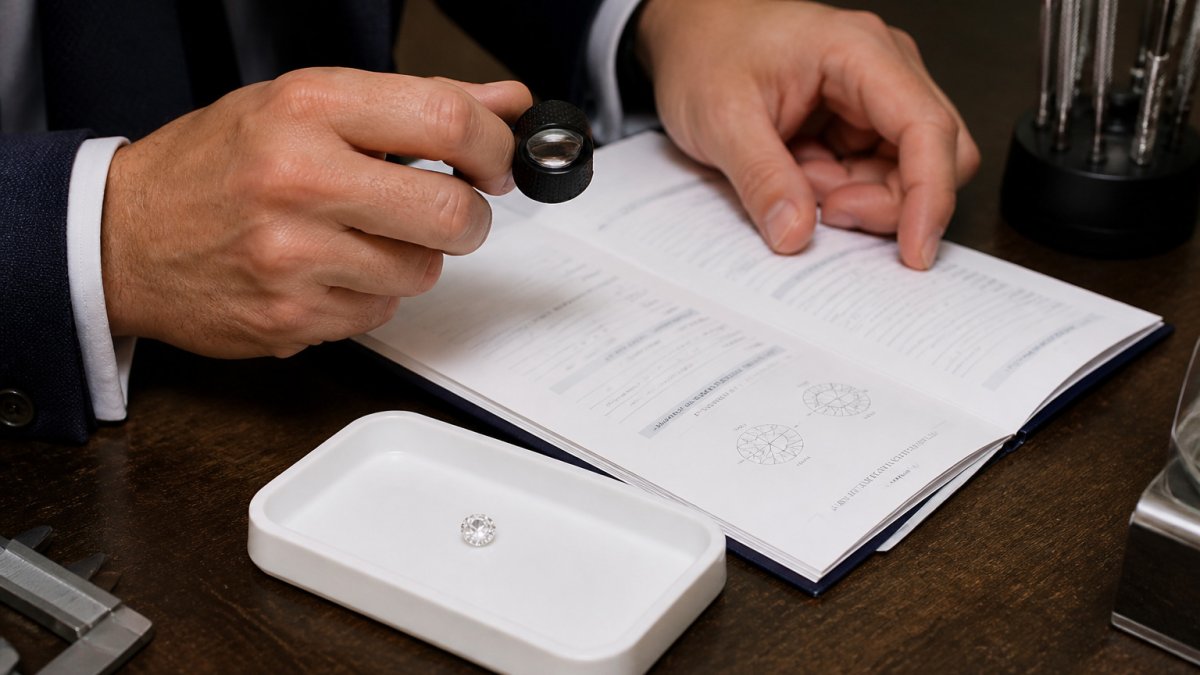
Part A: Item description and identification
- Metal type and purity (for example, "14K yellow gold," not just "gold")
- Carat weight, measured and stated to two decimal places
- Color, clarity, and cut grades, with the grading source named (GIA, AGS, or the appraiser's own opinion)
Part B: Report quality and independence
This is the part most appraisals fail, and it is where you separate a defensible valuation from a number typed on letterhead.
- Appraiser credentials are specific and verifiable. Look for a named credential such as Graduate Gemologist (G.G.) from GIA, Certified Appraiser of Personal Property (CAPP) from the International Society of Appraisers, or Member of the National Association of Jewelry Appraisers (NAJA). Verify the credential with the issuing organization, do not rely on a business card.
- The report states the value standard. "Replacement value," "fair market value," and "liquidation value" are different numbers. A report that does not name the standard cannot be audited.
- The valuation date is stated separately from the inspection date. These are often the same day, but not always, and the distinction matters when prices have moved.
If any item is missing, ask the appraiser to add it. A report that leaves out basic facts, or hides its own limits, is hard to rely on when an insurer or an heir asks how the number was reached.
The checklist splits into two parts: item identification and report quality. Each part has its own set of items to confirm.
| Checklist part | What it covers | Why it matters |
|---|---|---|
| Part A: Item description | Metal, carat, grades, measurements, photos | Lets you confirm the stone's identity |
| Part B: Report quality | Credentials, value standard, method, disclosures | Shows whether the valuation can be defended |
| Value standard | Replacement, fair market, or liquidation | Different standards produce different numbers |
| Valuation date | Stated separately from inspection date | Prices shift over time |
Step 3: Compare the Diamond Appraisal vs Grading Report
People often mix up the appraisal and the grading report. They answer different questions, and both matter.
A grading report from a lab such as GIA describes the stone's characteristics (The difference between a Diamond Grading Report and an Appraisal.).
When verifying accuracy, check that the two documents agree:
- Carat weight in the appraisal matches the grading report
- Color, clarity, and cut grades match
- The report number cited in the appraisal matches the one on the lab report
If they disagree, pause. A mismatch can signal an error in the appraisal or, in rare cases, a stone that does not match its paperwork.
Step 4: Understand How Diamond Appraisers Determine Value
Knowing the method helps you spot weak reasoning. But the deeper question, the one most guides skip, is whether the stated number is actually supported by evidence. Verifying a diamond's identity is not the same as verifying its value. Use this section to audit the number, not just the stone.
First, identify which value you are looking at
Appraisers work to different value standards, and the same diamond can carry very different figures under each:
- Replacement value (insurance): what it would cost to buy a comparable piece at retail today. This is typically the highest of the three and is the figure insurers use to set coverage limits.
- Fair market value: the price a willing buyer and willing seller would agree on, neither under pressure. This is the standard for estate tax and many legal proceedings.
- Liquidation or resale value: what you could realistically get selling to a dealer or at auction. This is usually well below replacement value.
A common and costly mistake is treating an insurance replacement appraisal as a resale estimate. If your report says "replacement value" and you are planning to sell, the number is answering a different question than the one you are asking.
Then, test whether the number is supported
Ask the appraiser, or read the report, for these four things:
- The comparable data behind the figure. A defensible appraisal cites recent sales of similar stones (comparable carat, color, clarity, cut, and lab) or names the price database used. "Based on market experience" is not data.
- The adjustments made. If the comparables differ from your stone in color or clarity, the report should explain how the appraiser adjusted the price up or down. Unexplained adjustments are where inflated values hide.
- The valuation date and the market it reflects. Diamond prices move. A figure supported by 2022 comparables may not reflect today's replacement cost. Check that the comparables are recent relative to the valuation date.
- The treatment of the setting and metal. The value of the mounting is separate from the stone. A report that folds a large setting value into the diamond figure without breaking it out is hard to audit.
Cross-check with independent data
Automated price tools can offer a useful sanity check. StoneAlgo, for example, bases its estimates on data from over 1 million diamonds, and Rapaport price lists are widely used as a wholesale reference. Treat any automated or list figure as a reference point, not a replacement for a professional review, these tools generally do not account for the setting, provenance, or the specific value standard your appraisal uses.
When the appraisal and the grading report disagree
If the grading report and the appraisal conflict on carat, color, clarity, or cut, resolve the conflict before you trust the value. A mismatch can signal a clerical error, a stone that does not match its paperwork, or a grading opinion that differs from the lab's. In order:
- Ask the appraiser to reconcile the difference in writing.
- If the stone's identity is in doubt, have it re-examined by an independent gemologist.
- If the value is in doubt, seek a second appraisal that uses the same value standard so the two figures are comparable.
Keep both documents and any reconciliation notes. If you file an insurance claim or an estate dispute, the documentation of how you arrived at the value is often as important as the value itself.
Step 5: Check the Appraisal Date and Market Conditions
Diamond prices change. A report written several years ago may no longer reflect what the stone would cost to replace.
Look at the appraisal date first. Most appraisals are valid for two to three years, so an older report may need an update before you file an insurance claim or divide an estate.
Also ask whether the appraiser considered recent market conditions. A report that ignores current pricing can be wrong in either direction.
Some situations call for an update sooner:
- You are adding the piece to a new insurance policy
- The estate has changed hands or the heirs have changed
- You plan to sell and need a current market value
Step 6: Get a Diamond Appraisal Second Opinion When Values Conflict
Sometimes two appraisals disagree widely. This happens to many families, and the gap can be frustrating. The fix is an independent second opinion.
Choose a second appraiser who:
- Has no connection to the first appraiser or to any sale of the piece
- Uses a clear, documented method
- Will explain the difference between their figure and the first one
Compare the two reports line by line. Most large gaps trace back to one or two inputs, such as the grading source, the value standard used, or the market date.
Keep both reports. If you file an insurance claim, the insurer may ask for documentation of how you arrived at the stated value.
Booking Your Appraisal Review With Sherwood Bridge Diamonds
If you have an appraisal you want checked, or you need a current valuation for insurance or estate settlement, Sherwood Bridge Diamonds can review it. Our team walks through the report, checks it against the diamond appraisal checklist above, and explains any gaps in plain terms.
Pricing depends on the piece, the type of appraisal, and the work involved. Contact Sherwood Bridge Diamonds for a current quote.
[Make an Appointment]
Frequently Asked Questions
How can I tell if a diamond appraisal is accurate?
Start by confirming the appraiser's credentials, such as Graduate Gemologist (GG) from the Gemological Institute of America or an accredited appraisal designation, and check that they have no financial stake in the sale. Then compare the appraisal's stone details, such as carat weight, color, clarity, cut and measurements, against a grading report from a recognized lab like GIA. The stated replacement value should also reflect current retail prices for comparable stones. If the stone's identity matches but the value differs sharply from another credible appraisal, that gap is a signal to seek a second opinion.
What should a diamond appraisal report include?
A complete report should identify the owner and the appraiser, state the purpose of the appraisal, and describe the item in detail, including metal type and purity, stone type, carat weight, color, clarity, cut grade and measurements. It should list any inscriptions, the report number of an attached grading report, and photographs of the piece. The report must state the value type, such as replacement or fair market value, the effective date and the appraiser's signature. Missing any of these elements makes the report harder to use for insurance claims.
Is a diamond appraisal the same as a diamond grading report?
No. A grading report from a laboratory such as GIA documents the stone's characteristics and assigns grades, but it does not state a dollar value. A diamond appraisal assigns a monetary value for a specific purpose, such as insurance or estate settlement, and relies in part on the grading report's details. Comparing the two confirms that the stone described in the appraisal matches the graded stone, while the value still needs separate review.
Can I get a second opinion on a diamond appraisal?
Yes. Many owners seek an independent second opinion when two appraisals produce very different values. A second appraiser should review the same stone with the original report and grading report in hand, and should explain the valuation method used. Choose a reviewer with no connection to the first appraisal or to any sale, since conflicts of interest can skew results. If the two valuations still disagree, ask both appraisers to document the comparable sales and pricing sources they relied on.