 ultimate-guide
How Do You Choose an Ethical Diamond Engagement Ring?
Last Updated: October 26, 2026
Quick Summary
An ethical diamond engagement ring is one where the diamond and precious metals are sourced to minimize harm to people, communities, and the environment through verified fair wages, safe operations, and a traceable supply chain from source to your hand.
- Lab-grown diamonds now account for 61% of engagement ring sales according to The Knot Real Weddings Study 2026.
- Lab-grown diamonds typically cost 30-40% less than mined diamonds of comparable quality.
- Kimberley Process Certification only prevents conflict diamonds; it does not verify fair labor, environmental standards, or community benefit.
- Ask your jeweler for written documentation including grading reports, origin certificates, and supplier certifications to verify ethical claims.
- Lab-grown diamonds powered by renewable energy have significantly lower environmental impact than those powered by fossil fuels.
Table of Contents
- What Makes an Ethical Diamond Engagement Ring
- How to Tell If a Diamond Is Ethical
- Lab-Grown vs. Mined Diamonds: Sourcing and Impact
- Understanding Ethical Diamond Certification
- Questions to Ask When Buying an Engagement Ring
- Red Flags and Limits of Ethical Claims
- Start Your Custom Ethical Ring Design
- Frequently Asked Questions
What Makes an Ethical Diamond Engagement Ring
The definition is straightforward; the execution is where couples hit friction. At Sherwood Bridge Diamonds, we guide couples through this decision, ensuring they understand the trade-offs and ask the right questions.
Lab-grown diamonds have shifted this conversation entirely. According to The Knot Real Weddings Study 2026, lab-grown diamonds now account for 61% of diamond engagement ring sales. That's not a niche anymore.
But lab-grown isn't automatically "more ethical" than mined, and mined diamonds aren't automatically unethical. The reality is messier and more interesting than the marketing suggests.
How to Tell If a Diamond Is Ethical
First, understand what "ethical" means for the specific diamond you're considering.
Conflict-free certification sounds definitive but carries real limits.
Wirecutter's guide to ethical diamonds explains that assessing ethical diamonds requires looking beyond conflict-free certification alone.
Lab-grown diamonds come with documented sourcing by nature, you know the controlled facility where it was created.
Mined diamonds require deeper digging.
The second step is asking for documentation.
Lab-Grown vs. Mined Diamonds: Sourcing and Impact
This comparison shapes your entire purchasing decision, and marketing from both sides often obscures the actual differences.
Labor practices in labs are typically better documented than in mining.
Mined diamonds carry real, documented environmental costs: habitat disruption, water usage, machinery emissions, and tailings management.
The cost difference is significant. According to Berman Jewelers' 2026 engagement ring trends, lab-grown diamond sales rose 46% in the previous year, driven partly by price advantage.
Lab-grown and mined diamonds differ significantly in how they are created, their environmental impact, and labor practices.
| Aspect | Lab-Grown | Mined |
|---|---|---|
| Creation time | Weeks or months | Years to decades |
| Creation method | HPHT or CVD processes | Extraction from earth |
| Environmental impact | Depends on facility power source | Habitat disruption, water usage, emissions |
| Labor transparency | Typically better documented | Varies widely by region |
| Cost comparison | 30-40% less than mined | Higher baseline cost |
| Supply chain | Single auditable facility | Multiple countries and intermediaries |
Understanding Ethical Diamond Certification
Certification creates the appearance of verification without always delivering it.
The Kimberley Process Certification Scheme prevents conflict diamonds but nothing else. A certified diamond came from a mine not financing armed conflict, that is the complete scope.
The Responsible Jewellery Council (RJC) Certification is more comprehensive, covering labor standards, environmental practices, and community engagement.
For lab-grown diamonds, look for grading reports from the Gemological Institute of America (GIA) or American Gem Society (AGS).
A Document-by-Document Verification Process
Treat each document as answering one narrow question. Stack them until the picture is complete, and note the holes.
- Grading report (GIA, AGS, or equivalent). Confirms the stone's identity, measurements, and, for lab-grown, that it was created in a lab. It establishes the stone is what the seller says it is, not where the rough came from or how workers were treated.
- Origin record or mine-of-origin notation. Confirms a claimed source. Ask for the mine name or lab facility name in writing. It establishes a traceable starting point, not that the operation met labor or environmental standards.
- Kimberley Process certificate. Confirms the rough was not used to finance armed conflict, a narrow conflict-free claim, not fair wages, safety, or environmental performance.
- RJC certification or audit summary. Confirms the operation underwent third-party review against labor, environmental, and community criteria, a broader responsible-sourcing claim, though not proof every subcontractor was audited.
- Chain-of-custody or supplier declaration. Confirms each handoff in the supply chain is documented, continuity from source to seller, though not that every intermediary told the truth, which is why you want the seller to stand behind it in writing.
- Metal sourcing documentation. Confirms recycled content or responsible-mine origin for the setting and band, the metal's provenance claim, not labor conditions at the refiner unless separately audited.
The trap is treating any single certification as complete ethical verification. Certifications are tools for verification, not substitutes for it. A certified diamond from a responsible source is a good signal; one you cannot trace further is one you cannot fully verify.
At Sherwood Bridge Diamonds, we work with suppliers who maintain certifications and provide origin documentation. We can trace your diamond's sourcing because we know our suppliers.
Questions to Ask When Buying an Engagement Ring
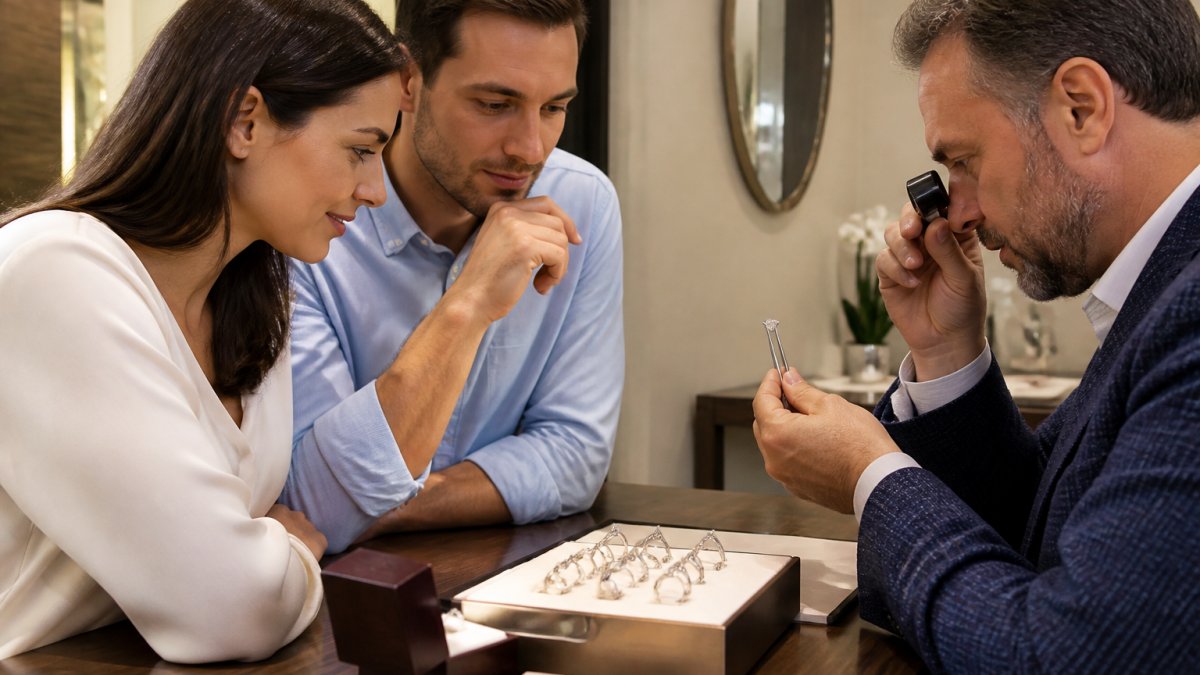
The questions you ask determine what you'll learn. Generic questions get generic answers; specific ones about sourcing, labor, and environmental impact get answers that matter.
On sourcing and origin:
- "Can you trace this diamond to its source, either the specific mine or the lab where it was created?"
- "Do you have documentation of the origin, such as a grading report with origin notation or a lab certification?"
- "If this is a mined diamond, what certifications does the mine hold? Kimberley Process, RJC, or others?"
On labor and safety:
- "Can you tell me about the labor practices at the mine or facility? What documentation do you have?"
- "Are there third-party audits of working conditions and wages?"
- "How do you verify that workers are paid fair wages and work in safe conditions?"
On environmental impact:
- "What environmental standards govern the mining or lab operation?"
- "For lab-grown diamonds, what is the facility's power source, renewable or fossil fuel?"
- "Are there published sustainability reports or environmental audits?"
On the metals:
- "Are the precious metals recycled, newly mined, or a mix?"
- "Do you have documentation of the metals' sourcing?"
- "What labor and environmental standards apply to metal sourcing?"
On verification:
- "Can you provide written documentation of all sourcing claims?"
- "What happens if I want to verify these claims independently?"
- "Do you offer any guarantee or documentation I can provide to my insurance company?"
A jeweler who answers directly and provides documentation takes ethical sourcing seriously. One who gets vague or defensive is telling you something important about how they actually source diamonds.
Red Flags and Limits of Ethical Claims
Not every ethical claim holds up under scrutiny. "Conflict-free," "ethical," and "sustainable" are not interchangeable, and each establishes less than most shoppers assume.
What Each Label Actually Establishes
- Conflict-free. In practice this usually means Kimberley Process compliance. It establishes that the rough did not finance armed conflict. It does not establish fair wages, safe working conditions, environmental performance, or community benefit. A diamond can be conflict-free and still come from an operation with a poor safety record.
- Ethical. An umbrella term with no single standard behind it. Depending on the seller, it may mean conflict-free plus RJC certification, or only that the seller feels good about the supplier. Ask which specific certifications and documents back the word; if the answer is vague, the claim is vague.
- Sustainable. Usually refers to environmental impact, but the scope varies widely. For lab-grown stones it may mean renewable-powered facilities; for mined stones, reclamation plans and water management. Neither is comparable across sellers without the underlying data. "Sustainable" without a defined metric is marketing.
A Practical Decision Framework
When labels conflict and documents have holes, work through this sequence rather than chasing perfect purity.
- Set your priorities first. Rank what matters most: environmental impact, labor practices, supply-chain transparency, cost, or a combination. Write the ranking down, it becomes the tiebreaker when options are close.
- Set a realistic budget. Stone type, setting, metal, certification, and customization each move the total. Decide what you will spend before you fall in love with a stone.
- Choose stone type against your priorities. Lab-grown tends to win on traceability and facility-level environmental control; mined can win when you can verify a specific responsible operation. Neither is automatically more ethical.
- Verify with documents, not adjectives. Use the document-by-document process above. If a claim cannot be documented, treat it as unverified.
- Weigh the trade-offs explicitly. A stone with strong labor documentation but weaker environmental data may still be right if labor is your top priority. Name the trade-off out loud so you are choosing it, not defaulting to it.
- Buy from a seller who answers in writing. The willingness to put sourcing claims in an email or contract is itself a signal.
Red Flags Worth Walking Away From
- Vague sourcing claims. "Ethically sourced" without specifics means nothing. Demand the mine name, the lab facility, the certifications, and the documentation.
- Certifications without traceability. A Kimberley Process certificate proves the stone is not a conflict diamond, nothing about labor or environmental practices. An RJC certification from a mine you cannot name is harder to verify independently.
- Pressure to skip documentation. A seller who discourages you from asking for paperwork is telling you something about how they source.
Perfect ethical verification does not exist. Supply chains are complex, documentation has limits, and every option involves trade-offs. What you can do is ask specific questions, demand documentation, rank your priorities, and work with jewelers who can actually answer you, not perfect, but a decision you can stand behind.
Start Your Custom Ethical Ring Design
Choosing an ethical diamond engagement ring deserves time and attention. The right choice depends on what matters most to you: environmental impact, labor practices, supply chain transparency, cost, or a combination.
From there, work with a jeweler who understands these nuances and can answer your questions.
The engagement ring you design should feel right, aesthetically and ethically. That means knowing where it came from and being confident in that choice. We're here to help you get there.
Frequently Asked Questions
How can you tell if a diamond is ethically sourced?
Request a certificate of authenticity and chain of custody documentation from your jeweler. Ask where the diamond originates and whether it comes from a certified supplier. For lab-grown diamonds, confirm the manufacturer and production facility. For mined diamonds, look for conflict-free certification and ask about the mining company's labor practices and environmental standards. Reputable jewelers like Sherwood Bridge Diamonds can provide full sourcing documentation and explain their supplier standards.
Are lab-grown diamonds more ethical than mined diamonds?
Lab-grown diamonds typically have a lower environmental footprint and eliminate concerns about conflict financing and unsafe mining conditions. However, they require significant energy to produce. Mined diamonds can be ethical if sourced responsibly with fair labor standards and environmental protections in place. The choice depends on your priorities: lab-grown excels in sustainability and traceability, while responsibly mined diamonds support established supply chains and communities. Both can be ethical when sourced from certified, transparent suppliers.
What ethical diamond certification should I look for?
Look for diamonds certified by independent gemological laboratories such as the Gemological Institute of America (GIA) or the American Gem Society (AGS). These provide grading reports that verify the diamond's characteristics. For conflict-free claims, the Kimberley Process Certification offers limited assurance; however, it does not verify labor practices or environmental impact. For lab-grown diamonds, ask for production facility certification. Beyond certification, request documentation of the supply chain and the jeweler's supplier standards, certification alone is not enough.
What questions should I ask a jeweler about an ethical engagement ring?
Ask: Where does the diamond originate and who is the supplier? Can you provide a chain of custody or sourcing documentation? For mined diamonds, what labor and environmental standards does the mining operation follow? For lab-grown diamonds, where is it produced and what energy sources power production? Is the metal recycled or responsibly sourced? A trustworthy jeweler will answer these directly and provide written documentation.
What is the average cost of an ethical diamond engagement ring?
The average engagement ring costs $4,600 in the United States, though ethical rings vary widely based on carat weight, diamond type, metal choice, and customization. Lab-grown diamonds typically cost 30-40% less than mined diamonds of similar quality. Pricing depends on your specific preferences, sourcing requirements, and design complexity. Contact Sherwood Bridge Diamonds for a personalized quote based on your vision and ethical priorities.
How do I verify a jeweler's appraisal and certifications?
Ask whether the jeweler holds professional credentials from organizations like the American Society of Appraisers (ASA) or the International Society of Appraisers (ISA). Request their appraisal methodology and whether they use independent gemological laboratories for grading. Ask for references and verify their insurance appraisal acceptance with your insurance provider. Reputable jewelers like Sherwood Bridge Diamonds provide certified, documented appraisals that insurance companies will accept. Never rely on a single appraisal; seek a second opinion if valuations differ significantly.
Will a lab-grown diamond hold its value for resale or insurance?
Lab-grown diamonds have strong resale value and are accepted by insurance companies when properly certified and appraised. However, their market value typically does not appreciate like mined diamonds because supply is unlimited. For insurance purposes, what matters is an accurate, certified appraisal, not the diamond's resale potential. Lab-grown diamonds are durable and identical to mined diamonds in physical properties, so they perform equally well as heirloom pieces. Discuss resale expectations and insurance coverage with your jeweler before purchasing.
Make an appointment with Sherwood Bridge Diamonds to design your custom ethical engagement ring. We'll walk you through sourcing options, answer every question about diamond origin and labor practices, and create a ring that reflects your values and your vision.